Canny (canny.io, the feedback tool, not the edge detector) keeps your customers' posts and votes in its own database and links them to GitHub issues from there. Gitback keeps them in GitHub itself: the Board is built live from your repository, and every post, comment and vote on it is a GitHub object authored by the person who made it.
| Canny (canny.io) | Gitback | |
|---|---|---|
| Where posts and votes are stored | Canny's database, linked to GitHub issues | Your repository's Discussions and reactions |
| Who counts toward the bill | Every tracked user: anyone who has given feedback | Nobody; pricing counts Boards |
| Who can write feedback | Anyone, including via Intercom, Zendesk, Slack or a Chrome extension | Anyone signed in with GitHub |
| Free tier | 25 tracked users, 5 managers | Unlimited open-source Boards |
| Paid pricing counts | Tracked users (Pro from $79/mo billed yearly) | Boards; see pricing |
| Private boards | On every plan, including Free | Paid Plans only |
| Custom domain | Pro and Business | Pro and above |
| GitHub link | Pro and Business; one issue per idea | The Board is the repository |
| Support-tool capture (Intercom, Zendesk, Gong) | Yes | No |
| CRM, SSO, SOC 2 | CRM and SSO on Business; SOC 2 on Pro and Business | Sign-in is GitHub only |
| Changelog | Hosted page and in-product widget | Read from GitHub Releases |
Canny facts are from Canny's own pages, read on 2026-09-24.
What is the difference between Canny and Gitback?
Canny is a hosted customer feedback product that sits beside your tools; Gitback is a front end on top of one GitHub repository. Canny describes itself as "a customer intelligence platform for product teams": it pulls feedback in from tools such as Intercom, Zendesk and Gong, deduplicates it, and ranks it with customer and revenue data.
A Gitback Board serves one Source Repo and carries five fixed Modules: feedback, roadmap, changelog, FAQ and issues. It reads the repository's Discussions, Issues and Releases, and it has no feedback source other than that repository. There is nothing to sync, because nothing is copied. Try it by pasting any public repository into Open a Board.
Where does each keep the feedback?
Canny keeps it in Canny. Its GitHub integration is a Canny app installed in GitHub that links an idea to an issue; the idea, its votes and its comments stay in Canny, each idea links to one issue, and the link is visible only to Canny admins.
Gitback keeps it in your repository, and this is the difference the rest of the page follows from. Gitback's product rule is "your feedback lives in your GitHub, not our database". In the code, every GitHub call that goes through Gitback's proxy is a registered operation, one file per operation, and the proxy answers anything not on that list with passthrough_refused. The feedback writes are:
createFeedbackDiscussion: a new post becomes a Discussion in the Board's feedback category, sent with the End User's own token so GitHub records them as the author.addDiscussionComment: a reply becomes a comment on that Discussion, authored the same way.addVote: a vote is a 👍 reaction on the Discussion, under the voter's own token. GitHub deduplicates it per account.addComment: when an item ships, the Client's close-the-loop comment lands on the Issue that asked for it.
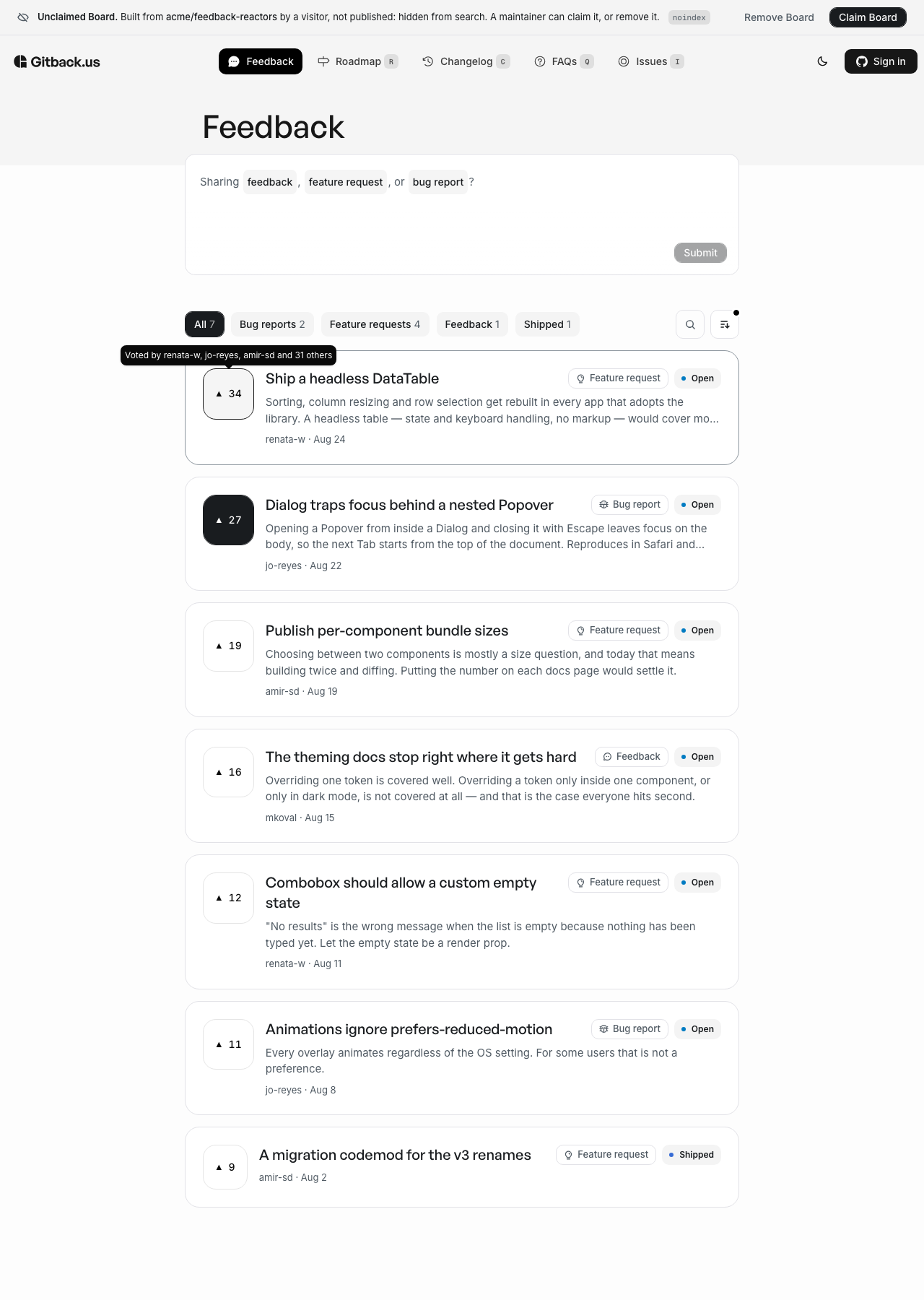
Because a vote is a reaction, the names behind it are GitHub accounts, and anyone can check them on github.com.
Gitback does hold some state of its own, and its business rules name all four kinds: a read cache, claim state, a takedown blocklist and Stripe billing entitlement. The cache is not optional. GitHub has no unauthenticated GraphQL API, so every anonymous read goes through one server-held Reader Token with 5,000 requests an hour for the whole deployment, and every Board read is counted against it.
What does each cost?
Canny prices by tracked users, where "a tracked user is someone who has given feedback". As of 2026-09-24 its pricing page lists:
- Free: $0 a month, 25 tracked users, 5 managers, unlimited feedback and boards.
- Pro: starts at $79 a month billed yearly, or $99 billed monthly, from 100 tracked users. On the monthly view the price climbs with the slider: $349 at 500 tracked users, $724 at 1,250 and $1,349 at 5,000.
- Business: custom pricing, from 5,000 tracked users.
Canny also warns that "If you haven’t set a monthly spend limit, we’ll automatically upgrade you", and that with a limit set it "will stop tracking feedback from new users".
Gitback prices by Board, not by people. Open-source Boards are free on every Plan, and a paid Plan adds private Boards and Custom Domains. The current prices are on Gitback's pricing page. A popular open-source project pays nothing more however many people vote, because votes are reactions on GitHub.
Where is Canny the better choice?
Canny is the better choice when your feedback comes from customers who are not on GitHub, or when the feedback has to meet revenue data. Specifically, Canny does things Gitback does not attempt:
- Capture from support tools. Canny's Autopilot "automatically captures, deduplicates, and triages feedback" from Intercom, Zendesk, Freshdesk, Gong, Zoom and more. Gitback reads one repository and nothing else.
- Revenue and prioritisation. Canny can sort requests by MRR impact, score and rank features, and list HubSpot and Salesforce CRM integrations on Business. Gitback holds no CRM or revenue data about the people who leave feedback.
- Closing the loop by notification. Canny notifies "the customers who requested a feature as it moves forward". Gitback's close-the-loop is a comment on the GitHub Issue, which reaches whoever GitHub notifies about that Issue.
- Enterprise requirements. Canny lists SSO through Okta, OIDC, Entra ID and OneLogin on Business, and SOC 2 on Pro and Business. Gitback's only sign-in is GitHub.
- Private boards on the free plan. Canny's Free plan includes private boards. Gitback's private Boards need a paid Plan.
- An in-product changelog widget. Canny offers one alongside a hosted changelog page, and its changelog is "free to use with no restrictions".
- Feedback from people who are not on GitHub. Canny captures feedback through Intercom, Zendesk, Slack and a Chrome extension on every plan. On a Gitback Board, reading is open but writing requires signing in with GitHub.
If your customers are shoppers, account managers or support tickets, Canny fits them and Gitback does not.
Who should pick Gitback?
Pick Gitback if your users already have GitHub accounts and your work already lives in a GitHub repository: open-source projects, developer tools, libraries and APIs. For them Gitback removes the second system. Feedback is a Discussion your team already watches, a vote is a reaction anyone can audit, the roadmap is lane labels on the repository's own open Issues, and the changelog is read from your Releases.
It also suits a team that does not want feedback held by a vendor. If Gitback went away, the posts, comments and votes would still be in the repository as ordinary GitHub objects. The features page has a short tour of the product, and the getting-started guide walks through opening and claiming a Board.
What does moving from Canny to Gitback involve?
Moving from Canny means starting the Board fresh, because Gitback has no importer. What Gitback writes to GitHub is the registered operations above, each one Discussion, comment or reaction created as the signed-in account; roadmap moves, which swap an item's lane labels; and files under .gitback/, committed by a footprint writer under the Client's own token. None of them reads from another tool or creates posts in bulk.
That rules out carrying votes across by design. A Gitback vote is a 👍 reaction authored by a real GitHub account, so a Canny vote cannot become one unless the person who cast it votes again on GitHub. A practical move looks like this:
- Open your repository's Board at /github and claim it with a GitHub account that has write access.
- Recreate the open requests you want to keep as Discussions, noting their Canny vote counts in the body.
- Point your users at the Board and let them vote there.
- Keep Canny read-only until the new Board has its own votes.
Existing GitHub Issues need no moving: they appear in the Board's issues Module, read from the repository. See all comparisons for other tools.
Frequently asked questions
Is there a free alternative to Canny?
Canny itself has a free plan, capped at 25 tracked users and 5 managers as of 2026-09-24. Gitback's open-source Boards are free on every Plan with no tracked-user count; private Boards and Custom Domains are what its paid Plans add.
Where does Gitback store feedback?
In the GitHub repository the Board is built for. A new post is a GitHub Discussion, a comment is a Discussion comment and a vote is a 👍 reaction, each written with the author's own GitHub token. Gitback's own store holds a read cache, claim state, a takedown blocklist and billing entitlement.
Can I import my Canny posts and votes into Gitback?
No. Gitback has no importer. Its registered GitHub writes create one Discussion, comment or reaction at a time as the signed-in account, so a Canny vote cannot become a Gitback vote without that voter casting it on GitHub.
Does Canny integrate with GitHub?
Yes, on its Pro and Business plans. Each Canny idea can be linked to one GitHub issue, the link is visible only to Canny admins, and the feedback itself stays in Canny.
Do people need a GitHub account to leave feedback on Gitback?
To write, yes. Anyone can read a Board, but posting, commenting and voting require signing in with GitHub, because each one is a GitHub object authored by that account.